Seven steps from the first question to day-to-day operation. You can join at any of them — and stop at any of them.
Get in touch Back to the overview
Consulting
It starts with one question: who should go through which door, when — and who should not. We survey your protection zones, rank them by how much protection they actually need, and say plainly where a card is enough and where only a biometric trait carries — one that cannot be lent, lost or copied. Operators of critical infrastructure get that mapping in the language they will later have to report in: KRITIS protection goals, NIS2 obligations, evidence. The result is not an order list but a basis for your decision.
Design
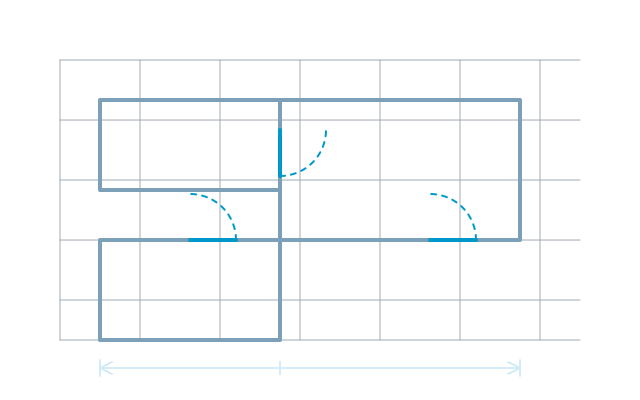
The concept becomes a plan: reader positions, turnstiles and interlocks, zones, cable routes, interfaces to whatever already runs in your building. Biometrics go where they are needed — at the perimeter, in front of the data centre, at the laboratory or armoury — and each with the fallback that day-to-day operation requires. We design for growth and for evidence: who was where, and when, has to be provable later, without collecting more personal data than necessary.
Installation
We mount, wire and commission — in an occupied building, and outside your hours where there is no other way. Every door is tested and handed over individually, every reader enrolled on site, every interface accepted against the specification. What was installed, how it is configured and which firmware version runs is documented in writing — together with the parts list you need for your own evidence and for the software bill of materials under the Cyber Resilience Act.
Training
A system is only as good as the people who operate it. We train your administrators on their own installation rather than on slides: roles and permissions, four-eyes approval, everyday use, faults, what to do in an emergency. And your users too, if you like, so the hand sits right the first time — acceptance of a biometric system is decided at the door, not in a data sheet. That includes what biometric data is and what happens to it.
Custom development
Where standard products fall short, we build: readers, sensors, protocol bridges, firmware, analysis. From the circuit board to the software in one place — with signed releases, secured updates and a documented supply chain, which is exactly where the Cyber Resilience Act will measure manufacturers. And documented so you can run the result without us.
Operation
Handover is not the end. We keep the system current, apply security updates, watch states and logs, and are reachable when a door does not do what it should. For operators with reporting duties that also means dependable logs, clear responsibilities and deadlines that fit NIS2. Maintenance on schedule, faults at short notice.
Documentation
What was built has to stay traceable without us. Handover includes the complete system documentation: as-built plans, reader positions and zones, parameter sets, interface descriptions, firmware and software versions with their bill of materials. Plus the evidence operators of critical infrastructure need for audits and reports — acceptance records, change history, responsibilities. It is kept current, not written once.